
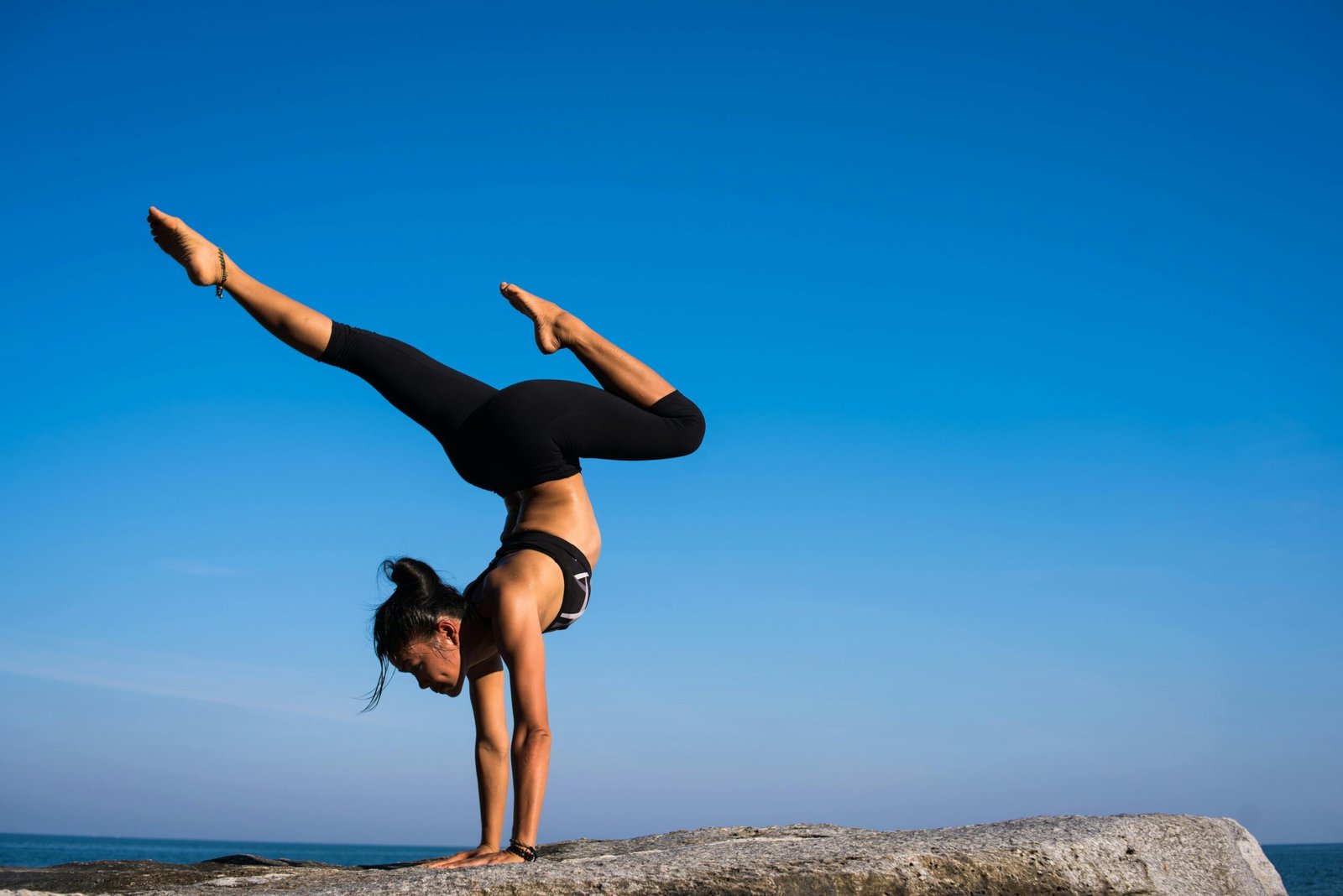
The handstand is often called the “crown jewel” of bodyweight training. It is a skill that commands immediate respect, demonstrating a unique blend of strength, control, and spatial awareness. However, most people approach the handstand as a simple feat of “kicking up and hoping for the best.”
If you want to master this movement, you need to understand that a handstand is a skill, not just a strength exercise. This guide will move beyond the basic advice found on most blogs. By incorporating biomechanical research and proven gymnastic progressions, you will learn how to build a “race car” of a handstand from the ground up.
Why You Fall
To stay upside down, you must control your Center of Mass (COM) over your base of support, your hands. In a standing position, your feet have a large surface area and your center of gravity is relatively low. When you flip upside down, the distance between your base and your center of gravity increases significantly, which inherently decreases your stability.
Research shows that successful handstands rely on two things:
- The Wrist Strategy: This is the most critical tool for balance. To keep your COM from falling toward your back, you must press through your fingertips to create “wrist torque”.
- Angular Momentum: While the wrists do the heavy lifting, your shoulders and hips also make micro-adjustments to regulate your body’s rotation.
Experts use their hips differently. Skilled performers maintain a more acute “pike” position during the initial lift and use their hip flexors to “lock in” the final vertical line. Beginners, on the other hand, often rely too much on their shoulders, leading to a “banana back” shape that is nearly impossible to balance.
Phase 1: Building a Weight-Bearing Foundation
Before you ever kick up, you must prepare your joints. A handstand places (100%) of your body weight onto your wrists at an extreme angle. If your wrists aren’t conditioned, you risk tendonitis and forced breaks from training.
Wrist Conditioning
Dedicate (5-10) minutes of every session to wrist prep. Useful drills include:
- Wrist Rocks: Kneel on the floor and lean forward over your hands to increase the angle of extension.
- Palm Lifts: Keep your fingers on the ground while lifting only the palms of your hands to build forearm strength.
- Crawling: This is an underrated way to get used to having a heavy load on your hands while moving.
Shoulder Elevation
In a handstand, you don’t just “hold” your weight; you must actively “push the ground away”. This requires full shoulder flexion of 180 degree and scapular elevation (shrugging your shoulders toward your ears). If your shoulders are “lazy” or lack mobility, your ribs will flare out, and your lower back will arch.
Phase 2: Mastering the Hollow Body
The secret to a “straight” handstand isn’t in the legs; it’s in the core. Gymnasts use the “hollow body” position to create a rigid, unified column of tension. If your body is floppy, any movement in your feet will travel down and wobble your hands. If your body is a solid “stake,” you only have to balance the bottom of the stake.
How to practice the Hollow Body:
- Lie on your back with your lower back pressed firmly into the floor.
- Lift your legs and shoulders slightly off the ground.
- Reach your arms overhead, keeping your ribs pulled down (not flared).
- Hold this for (30-60) seconds.
A handstand is essentially a vertical hollow body. If you cannot maintain this tension on the floor, you will not be able to maintain it while inverted.
Phase 3: Overcoming the Fear of Falling
The biggest barrier for most beginners isn’t strength; it’s the fear of falling over. This fear is a survival instinct, but it will prevent you from ever fully committing to a vertical position.
To “ditch the fear,” you must learn how to “bail” safely. The most effective method is the Wheel Out (also known as the cartwheel bail):
- As you feel yourself falling “over” (toward your back), shift your weight onto one hand.
- Lift the other hand and turn your body to the side.
- Step one foot down to the floor, essentially cartwheeling out of the move.
Practice this bail intentionally. Start from a low kick-up and gradually get higher until you can bail comfortably from a full vertical position.
Phase 4: The Progressive Path to Freestanding
Do not start by kicking up in the middle of the room. This leads to “random attempts” that don’t build skill. Instead, use the wall as your primary training partner.
Level 1: The Wall Walk
Instead of kicking your back to the wall, start in a plank position with your feet against the wall. Walk your feet up the wall while walking your hands toward it. This “chest-to-wall” position is superior to “back-to-wall” because it forces you into a better alignment and prevents the “banana back”.
Level 2: The L-Stand
Place your hands on the floor about a leg’s distance from the wall. Walk your feet up the wall until your body forms a right angle ((L)-shape). Your feet should be at hip height. This drill is incredibly demanding because it puts your weight directly over your wrists while allowing you to focus on your shoulder “push”.
Level 3: Scissoring into Balance
Once you are comfortable in a chest-to-wall handstand, pull one leg off the wall and keep it vertical. Slowly use your fingers to “grip” the floor and pull the second leg off the wall to meet the first. This “scissoring” method prevents you from using too much momentum, which is the most common reason people overbalance.
The Secret of the “Wrist Strategy”
Once you are away from the wall, how do you actually stay there? This is where the biomechanics of the wrist come into play.
Balance is a constant state of correction. You are never truly “still.” Instead, you are constantly falling and catching yourself.
- If you fall toward your back (Overbalance): Dig your fingertips into the floor as hard as you can. This creates a force that pushes you back toward the center.
- If you fall toward your feet (Underbalance): Release the pressure from your fingers and shift the weight into the “heel” of your palm.
Think of your hands like feet: your fingertips are your “toes” and the base of your palm is your “heel.” You balance on your hands just like you balance on your feet, by shifting pressure between the front and back.
Floor vs. Apparatus
Not all handstands are created equal. Research into muscle activation shows that the apparatus you use changes which muscles work hardest.
- The Floor: This demands serious wrist strength to help you stay balanced.
- Parallel Bars: Reduces the demand on your wrist because you can use the bars to “grip” and adjust balance with your whole hand.
- Still Rings: This is one of the most challenging skills, even for experienced gymnasts. Because the rings are unstable, your shoulders and upper body have to work extra hard to keep you steady and controlled.
For most beginners, the floor is the best place to start because it provides a stable base to develop the “primary wrist strategy”.
Common Mistakes and How to Fix Them
- Flaring the Ribs: This is usually a sign of poor shoulder mobility. If you can’t get your arms behind your ears without arching your back, you need to work on your overhead flexibility.
- Looking at the Floor too Hard: While you should look at the space between your hands, pulling your head back too far will cause your spine to follow, creating an arch. Keep your neck neutral.
- Bent Elbows: As soon as your elbows bend, the handstand becomes a feat of tricep strength rather than a feat of skeletal alignment. Lock your elbows “dead straight” and imagine “growing taller” through your shoulders.
- Kicking with too much Force: Many beginners “throw” their legs up. This creates too much angular momentum to control. Instead, try to “float” up by keeping your COM over your hands as early as possible.
Creating a Training Plan
You cannot master the handstand by practicing once a week. It is a neurological skill that requires high frequency. Aim for (3-5) short sessions per week, lasting (15-20) minutes.
A Sample Session Structure:
- Warm-up ((5) mins): Wrist rocks, palm lifts, and hollow body holds.
- Skill Work ((10) mins): Wall walks, L-stands, or chest-to-wall balance holds.
- Conditioning ((5) mins): Pike push-ups or shoulder taps to build the “push” endurance.
Progress takes time. For most self-taught adults, achieving a consistent (10-30) second freestanding handstand takes between (6) to (13) months of dedicated practice.
Learning to do a handstand is one of the most rewarding physical journeys you can undertake. It changes your perspective and teaches you how to listen to the subtle signals of your own body.
Remember the “race car” analogy: don’t be in such a rush to “run” (kick up) that you forget to build the “engine” (shoulder strength) and the “tires” (wrist conditioning). If you build the foundations correctly, you will eventually “overtake” everyone who tried to skip the basics.